
RESOLVING TRADE MARKING OF ‘HAKUNA MATATA’ SLOGAN
RESOLVING TRADE MARKING OF ‘HAKUNA MATATA’ SLOGAN
The Protection of Traditional Knowledge and Cultural Expressions Act (PTKCEA) was adopted in August 2016.
The trade marking of the Kiswahili slogan by Disneyland, a national cultural heritage of coastal Kenyan communities in the form of language, is a violation of the Act.
The commentary by Cathy Mputhia in the November 25,2018 edition of the Business Daily newspaper concerning the trade marking of the Kiswahili slogan ‘hakuna matata’ by Disneyland in the US raised vital issues on the misappropriation of the cultural heritage of Kenyans. The author emphasised the need to establish a structured legal framework to protect our national and regional cultural heritage.
A comprehensive legal framework proscribing the commercial misappropriation of traditional knowledge and cultural heritage of Kenyan communities already exists, and the question is largely that of effective implementation.
The Protection of Traditional Knowledge and Cultural Expressions Act (PTKCEA) was adopted in August 2016. The trade marking of the Kiswahili slogan by Disneyland, a national cultural heritage of coastal Kenyan communities in the form of language, is a violation of the Act.
It particularly exemplifies the continued misappropriation of the indigenous knowledge of Kenyan communities. Previously, there have been documented incidents of top global corporations such as Calvin Klein, Louis Vuitton and Jaguar Land Rover exploiting the Maasai community’s name, traditional knowledge and cultural heritage in the branding of their products for immense commercial benefits without the community receiving any royalties.
It is regrettable that most Kenyan communities are unaware that some of their indigenous knowledge and cultural expressions may have immense value in diverse aspects of human processes and ventures such as health, entertainment, conservation of biodiversity and agriculture. The theory behind the grant of intellectual property rights, including those of a trade mark, is largely oriented toward the protection of demonstrable inventiveness, creativity, distinctiveness and labour by the beneficiary.
It is, thus, questionable whether Disney can demonstrate the enumerated prerequisites sufficiently in the context of their claim for the ‘hakuna matata’ generic Kiswahili slogan, which is part of the cultural heritage of East Africans, without even minimal efforts to modify the phrase. Indeed, it does not make legal sense for a corporation to claim exclusive private legal rights in the commercial utilisation of a generic slogan.
However, based on the fact that the US rapid technological and economic development was significantly due to the allocation of exclusive legal rights over innovations, it has generally been liberal in granting intellectual property rights to American citizens and corporations even in questionable circumstances, such as is the case concerning the hakuna matata mantra.
It is upon the Kenya Industrial Property Industrial Property (KIPI), the institution charged with registration of trademarks, and the Kenya Copyright Board (KECOBO), the state corporation mandated by the PTKCEA to administer indigenous knowledge, to collaboratively and vigorously petition the US Patent and Trademark Office to withdraw the unjustifiable trade mark.
In a widely documented precedent setting matter, the US granted two researchers at the University of Mississippi Medical Centre a patent for a wound-healing medicinal powder made from turmeric extract. The Indian Council of Scientific and Industrial Research filed objections at the US Patent and Trademark Office and successfully demonstrated that turmeric, an indigenous plant in the country, had for centuries been utilised by communities in India in the treating of wounds. The patent was withdrawn on the basis of lack of novelty due to prior usage of the product in India.
KIPI and KECOBO, and other relevant state agencies, should also push for Kenya to ratify the 2010 Swakopmund Protocol on the Protection of Traditional Knowledge and Expressions of Folklore. The continued failure of Kenya to ratify the Swakopmund Protocol is ill advised and fundamentally inappropriate.
The Protocol was adopted under the auspices of the African Regional Intellectual Property Organisation (ARIPO), and establishes vital collaborative legal, policy and institutional mechanisms for the regional protection of indigenous knowledge and cultural heritage.
The ratification of the Protocol is an ideal starting point to the prevention and remedying of misappropriation of the traditional knowledge and cultural expressions in foreign jurisdictions, as it creates international mechanisms, obligations and standards against infringement, in addition to establishing obligations for cross boundary cooperation. For instance, Kiswahili maxims are a cross-border cultural heritage within the East African region.
It should be noted that developed states have historically successfully subjugated the protection of indigenous knowledge and cultural heritage, to the benefit of their transnational corporations that continue to expropriate such heritage. In that context, despite being a vital resource and form of intellectual property, such knowledge was left out of the World Trade Organisation (WTO) administered Agreement on Trade-Related Aspects of Intellectual Property (TRIPS) that generally covers most types of intellectual property.
Leaving indigenous knowledge and cultural expressions of African communities outside the scope of the obligation for protection across states, in international legal instruments such as TRIPs, created a lacuna that has permitted their continued misappropriation.
TOM KABAU, Advocate and Chair of the Law, Science and Technology Department at the School of Law, JKUAT.


IVORY COAST ACCEPT TO HOST AFCON 2023 INSTEAD OF 2021 TOURNAMENT
IVORY COAST ACCEPT TO HOST AFCON 2023 INSTEAD OF 2021 TOURNAMENT
Ivory Coast have now made a U-turn on Afcon 2023, having initially approached the Court of Arbitration of Sports declining to be moved from Afcon 2021
The Federation of Ivorian Football (Fif) has accepted to host the 2023 Africa Cup of Nations (Afcon) instead of the 2021 edition.
This comes after Cameroon were asked by Caf to organise the 2021 tournament which had initially been scheduled to be staged by Ivory Coast.
Cameroon had been stripped of the 2019 hosting rights before they were handed the 2021 mandate, but Ivory Coast appealed to Court of Arbitration for Sports (CAS), insisting on sticking to the original hosting programme.

Michael Madyira

EGYPT WITNESSES DEVELOPMENT IN TERMS OF INTERNATIONAL ARBITRATION IN MENA
EGYPT WITNESSES DEVELOPMENT IN TERMS OF INTERNATIONAL ARBITRATION IN MENA
Egypt is a pioneering country in terms of international arbitration in the Middle East and North Africa (MENA) region, according to the participants in a conference held by American Chamber of Commerce in Egypt (AmCham Egypt) on Tuesday. The conference announced the results of a survey conducted by Queen Mary University in London, in cooperation with the White and Case LLP International Law Firm, over international arbitration.
The participants said that the survey’s results are good indicators of Egypt’s investment climate, as well as the strong legislative structure prepared by the state in the past period, to develop the settlement procedures of economic disputes through international arbitration.
Head of the AmCham Egypt’s Legal Committee, Hany Sari Eldin, said that the issuance of Egypt’s arbitration law in civil and criminal cases, and the support of Appeal and Cassation Courts have strengthened Egypt’s competitiveness in this vital field.
He added that Egypt has also observed a noticeable development in terms of executing verdicts of international arbitration cases.
Sari Eldin called on state institutions to be more decisive in terms of issuing documents and procedures related to international arbitration, especially in cases filed against the government, in order to preserve the rights of the state.
Head of the Cairo Regional Centre for International Commercial Arbitration (CRCICA), Ismail Selim, said that the number of cases tried by the centre reached about 1,285.
He added that the CRCICA were found to be the lowest in terms of arbitration expenses, amounting to $3m compared to 18 other arbitration centres.
He pointed out that several countries, including England and Singapore, append the costs of international arbitration to the GDP, adding that Egypt should follow in these countries’ footsteps, especially that international arbitration significantly contribute to the GDP.
John Welms, representing White and Case LLP, said that Egypt has a good reputation in commercial arbitration, enabling it to become a competitor in this endeavour in the Middle East.
Daniel Garten also from White and Case said that the survey, which included 922 institutions, revealed that 9% prefer to file their international arbitration cases in the Middle East, while 10% choose Africa, and 14% choose Latin America.
Furthermore, Garten indicated that 97% of investors preferred international arbitration than local judiciary. According to the survey, this percentage is divided into 85% in the oil and gas sectors, 82% in the construction sector, 81% in the technology sector, and 56% in the banking and finance sector.
BCM ACQUISITION OF NZEMA MINE ON HOLD
BCM ACQUISITION OF NZEMA MINE ON HOLD
KWAKU ASOMAH-CHEREMEH
An Accra High Court (Commercial Division) has placed an interlocutory injunction on the sale of the Nzema Mine at Teleku Bokazo in the Western Region pending the resolution of a dispute in respect of royalties payable to African Champion Industries (ACI).
ACI is claiming from Adamus Resources Ltd. (Adamus) and BCM International Ltd. (BCM), approximately US$7 million in unpaid royalties covering the period – 2011 to 2018 – in respect of its interest in the Nzema Mine.
The injunction comes at the back of arbitration proceedings initiated by ACI in the Ghana Arbitration Centre where it claims BCM and Adamus have failed to honour their royalty agreement.
The court presided over by Justice George Buadi granted the application and restrained the defendant companies from paying or receiving monies due the plaintiff or agents, assigns, associates or representatives under the sale of the mining concession.
The court also ordered that the defendants should “preserve 3% of the net profits from the mine or 1% of the sales turn over which is higher from January 2018 into a high interest account”.
PETITION
Meanwhile, ACI has petitioned the Minister of Lands and Natural Resources, Kwaku Asamoah-Cheremeh, to intervene in the royalty payment dispute between the three companies.
In its summary of facts, ACI avers that it has a royalty agreement with Adamus on the Nzema Gold Mine at Teleku Bokazo, and has been receiving royalty payments from Adamus for gold produced from this mine since 2012.
It said BCM, an Australian contract mining company owned by Paul and Angela List, acquired Adamus in late 2017 and this acquisition transformed BCM from solely being a contract miner to being a mine owner and operator.
“From when Paul and Angela List became aware of the ACI royalty in February, royalty payments have been halted, and all communications from ACI to Adamus/BCM have been ignored. Per the Royalty Agreement, ACI has informed Adamus by letter of its intent to seek arbitration, and has commenced the arbitration process”, the petition stated.
It said Adamus responded by claiming that the royalty agreement is no longer in effect and that “the $3 million in royalty payments made to ACI were made in error”.
ACI avers that the decision by Adamus not to pay its royalty per the existing agreement has led to it being delisted from the Ghana Stock Exchange because its financial situation is “significantly threatened” by Adamus’ non-payment of the royalty.
The petition is therefore urging the minister to prevail on Adamus and BCI “to make full payment of the outstanding royalty amount due ACI, plus accrued interest, plus costs of legal counsel, plus cost of relisting on GSE, plus a financial penalty to deter this type of predatory behaviour by foreign companies towards local suppliers”.
“Perform a third party audit of the historical operations of the Nzema Mine to verify that the royalty payments made to ACI to date were actually correct, cost of same to be borne by Adamus/BCM.”
It is also asking the minster to ensure that going forward, monthly third party verification of the royalty amount due ACI and ongoing cost of same to be borne by Adamus/BCM, to ensure accuracy of payment.
Gibril Abdul Razak

TOP COURT DISMISSES APPEAL ON ARBITRATION AWARD
TOP COURT DISMISSES APPEAL ON ARBITRATION AWARD
Singapore’s top court has ruled in favour of Lesotho against a South African diamond mining company seeking to restore an arbitration award on its mine leases expropriated by the kingdom.
The Court of Appeal, in the first application in Singapore involving an investor-state arbitral award dispute from Africa, dismissed the appeal against a Singapore High Court decision to set aside the award.
The appeal, heard by a five-judge court presided over by Chief Justice Sundaresh Menon, underscores Singapore’s growing profile as a seat for arbitrations in general, and for investment arbitrations in particular, lawyers told The Straits Times.
Investment arbitrations are a form of arbitration directed against states, and usually brought under a foreign investment treaty or a free trade agreement.
The case is also significant as the parties chose Singapore for their arbitration although it did not concern Singapore or Singapore law. But the appeal enabled the courts here to address important issues of international law.
In the case, Swissbourgh Diamond Mines and other investors claimed their mining leases in Lesotho had been unlawfully expropriated and sought redress. Lesotho is one of 15 member states of the Southern African Development Community (SADC) which set up a regional tribunal to hear investment claims.
An SADC tribunal approached by the investors in 2009 was dissolved by its member states before the claim could be heard.
In 2012, Swissbourgh took the case to the Permanent Court of Arbitration (PCA), which ordered a new tribunal be formed to hear the expropriation claims.
But last year, Lesotho successfully applied to the Singapore High Court to set aside the PCA’s award.
Swissbourgh and the South African investors appealed in May this year to the top court, comprising CJ Menon and Judges of Appeal Andrew Phang, Judith Prakash, Tay Yong Kwang and Steven Chong.
Representing them was Queen’s Counsel Stephen Jagusch as briefed by a WongPartnership team led by Senior Counsel Alvin Yeo. Lesotho was defended by QC Samuel Words-worth as briefed by a Rajah & Tann team led by Mr Paul Tan Beng Hwee.
The court also appointed Queen’s Counsel J. Christopher Thomas and Professor N. Jansen Calamita from the National University of Singapore to help the court as amici curiae, which means friends of the court.
The appeals court, in its 160-page judgment, made clear it had the jurisdiction to set aside the award based on the cited provisions in UNCITRAL Model Law, which is a regime prepared by the United Nations Commission on International Trade Law that countries can use as part of their domestic legislation on arbitration. The court said, among other things, that the PCA tribunal had no jurisdiction to determine the claim of Swissbourgh and the investors.
“We find that there are no relevant disputes that concern any obligation that was owed by the kingdom in relation to the admitted investment. Finally, we also take the view that (Swissbourgh) may not have exhausted their local remedies,” wrote CJ Menon in judgment grounds issued on Tuesday.
The court also called Swissbourgh’s claim of “a lack of judicial independence in the kingdom’s courts spurious”, given that the courts had not hesitated to be “critical and dismissive of the actions of (their) own government”.

HOW FKF PLOTS TO TAKE FULL OWNERSHIP OF KPL
HOW FKF PLOTS TO TAKE FULL OWNERSHIP OF KPL
The Football Kenya Federation is set to take over the Kenyan Premier League Limited upon the expiry of the league managers’ contract between the two parties in September 2020.
This was revealed by the president Nick Mwendwa in a one-on-one interview with Nation Sport.
Mwendwa said that among other things to be reformed was having an elected chairman at the KPL whose offices will be moved to the Goal Project at Kasarani where the federation is based.
The move is to avoid wrangles between the league and the federation that have become part of the Kenyan football scene.
Under current KPL rules the club that wins the league provides the chairman of the KPL Governing Council.
“We are likely to register a new entity and configure it properly. We will not have the company as it’s constituted today but still we will have an independent entity that runs the league from the federation secretariat because we’ve enough space,” said Mwendwa.
“We don’t want a revolving door in the leadership of the company that every year we’ve a chairman. We shall have an elected chairman who is neutral and who will sit on the executive of FKF,” he added.
Further, the federation will not interfere with the commercial activities of the league managers.
“We are getting into a phase whereby all our league matches will be produced, that’s why we bought the Outside Broadcast (OB) van. We want to own content so that when Facebook comes tomorrow, we can package and give out our content. KPL understands this is the path we are going to take once the contract ends next year,
“We will not touch their money meant to be distributed to clubs and pay the federation 15 per cent. There work will remain in commercialising the league and not be the whistle-blower in terms of football rules and officiating,” he explained.
The changes however are subject to his re-election into the second term during the February 2020 elections.
“I am happy that members have allowed us to run our affairs smoothly, since last year there has not been any furore on the game.
The spirit has started to be understood. This is what I would like to see when I get another four-year term,” said Mwendwa.
Meanwhile, the federation boss is set to travel to France this week to arrange for Harambee Stars’ three-week camp for the 2019 Africa Cup of Nations (Afcon) that will be staged in Egypt from June 21.
Before that, Mwendwa will be in Lucerne, Switzerland next Wednesday to defend an appeals case filed by former Harambee Stars coach Adel Amrouche against FKF at the Court of Arbitration for Sports (CAS).
The appeal is listed on CAS website as case number 2018/A/5573 (Football Kenya Federation v Adel Amrouche) and 2018/A/5572 (Adel Amrouche v Football Kenya Federation).
“We are basically challenging to see if we can lessen that debt because at that time he had been suspended by Caf,” said Mwendwa.
Amrouche, who led Stars to the 2013 Cecafa Senior Challenge Cup, appealed against Fifa’s ruling directing FKF to pay him Sh60 million for terminating his contract in May 2014.
The Algerian-born Belgian, who was named Stars coach in February 2013, penned a new five-year deal in January 2014 which would have seen him take home Shs2.5 million per month.
Through his lawyer Vitus Derungs, the Belgian lodged a claim with Fifa’s Player Status Committee on March 4, 2016 demanding Sh132 million and an additional Sh5 million compensation for wrongful dismissal.
Judge Geoff Thompson on January 25 this year directed FKF to pay the 50-year-old, within 30 days, the Sh60 million plus five per cent per annum of the said amount from March 4, 2016 until the date of the end of his deal (January 2019).
Both FKF and the Belgian appealed the decision with Amrouche seeking more payment.
SERVICE OF PROCEEDINGS ON A FOREIGN STATE IS MANDATORY
SERVICE OF PROCEEDINGS ON A FOREIGN STATE IS MANDATORY
An arbitration award cannot be enforced in England against a foreign State without serving the proceedings on that State through the diplomatic channels.
In General Dynamics UK Ltd v Libya [2019] EWHC 64 (Comm), Males LJ, sitting in the Commercial Court, set aside parts of an order granting permission to enforce an arbitration award against Libya because the order was not served on the State in the manner required by the State Immunity Act 1978 (SIA). The court held that section 12(1) SIA, which provides for service through the Foreign and Commonwealth Office (FCO) of any “writ or other document required to be served for instituting proceedings against a State” is mandatory and the court is not permitted to validate an alternative method of service that does not comply with section 12 SIA.
FACTS
The Claimant, a UK company, successfully brought claims in arbitration resulting in an award of nearly £16 million award against the State of Libya (Award). The underlying dispute arose out of a contract between the parties for the supply of communications systems. Although Libya had participated in the arbitration proceedings which took place in Geneva, by the time of the enforcement proceedings in England it had made no effort to satisfy the Award.
THE JULY 2018 ORDER
As it was a New York Convention award, the Claimant made an application without notice to enforce the Award under section 101 of the Arbitration Act 1996 (Arbitration Act). On 20 July 2018, Teare J made an order (Order) by which he gave permission to enforce the Award as a judgment of the Court and, under CPR 6.16 and 6.28, permitted the Claimant to dispense with service of the arbitration claim form, the Order and related documents. It was considered sufficient for the Claimant to courier these documents to the Libyan authorities and to the law firm in Paris which represented Libya in the arbitration proceedings.
THE STATE’S APPLICATION TO SET ASIDE THE ORDER
Libya applied to set aside and vary parts of the Order on the basis that the Order was equivalent to a claim form and therefore constituted the document “instituting proceedings” within the meaning of section 12(1) SIA. Accordingly, it had to be served on Libya through the FCO channels. Libya’s alternative argument was that the Court’s power to dispense with service should only be exercised in exceptional circumstances under CPR 6.16, and that no such circumstances existed in this case.
DOES THE COURT HAVE POWERS TO DISPENSE WITH THE SERVICE REQUIREMENT?
Males LJ set aside the provisions of the Order that dispensed with service of the enforcement documents and permitted the Claimant to courier the documents to Libya’s representatives. Males LJ observed that even where service of the arbitration claim form was not required, section 12 SIA “contemplates that there will always be some document required to be served for instituting proceedings against a state”. He held that the order permitting the enforcement of an award is the document instituting proceedings for the purpose of SIA.
In reaching his decision, Males LJ reviewed existing case law that dealt with the Court’s power to dispense with service under section 12(1) SIA. Although he accepted that, unlike in previous cases, Libya took part in the enforcement proceedings, he disagreed with those decisions which held that the Court has the power to dispense with what are expressed to be the mandatory service requirements of SIA. Males LJ noted that the FCO, as part of the executive (the State organ tasked with conducting the UK’s relations with other sovereign States) is better placed to know “whether, when and how a foreign state should be made subject to the jurisdiction of the English courts”. Males LJ noted that any other finding would be contrary to the “clear and mandatory terms” of section 12 SIA, which when read with section 1 SIA, clearly emphasises that a foreign State’s immunity from the jurisdiction of the English courts is the default rule unless the SIA provides for an exception (on which see the conclusion below regarding the exception for contractually agreed service provisions in section 12(6) SIA).
IF THE COURT HAS THE POWER TO DISPENSE WITH SERVICE, SHOULD IT EXERCISE THIS POWER?
Males LJ noted that if he was wrong about the mandatory nature of section 12(1) SIA and the Court had the power to dispense with service of the Order under CPR 6.16, the Claimant would need to demonstrate that there were “exceptional circumstances” that justified such a decision. Given the difficult security situation in Libya, the strong policy in favour of honouring and enforcing arbitration awards and Libya’s awareness of the Award, Males LJ observed that there were exceptional circumstances in this case. However, this issue did not arise given the judge’s decision that service under section 12 SIA was a provision from which no derogation was possible.
COMMENT
The decision highlights the procedural difficulties that an award creditor can face when seeking to enforce an award against a State in England & Wales. Although the English courts are renowned for their pro-arbitration stance, pro-arbitration considerations can often conflict with and need to be balanced against other legal doctrines, such as sovereign immunity. Males LJ was keen to emphasise that the lengthy and time-consuming service provisions set out in the SIA reflect the fact that service on a State is a form of interference with its sovereignty, and therefore service needs to be effected sensitively through the diplomatic channels.
For corporates entering into commercial transactions with State or quasi-State entities, the practical takeaway from this decision is to ensure that alternative methods of service are included in their contracts. This approach is expressly permitted under section 12(6) SIA, and permits a State to designate an agent for service of process. Some States will agree to designate a particular embassy to receive originating court documents. The result is that claimants litigating against a State save considerable amounts of time that would otherwise be lost waiting for service to be effected through the diplomatic channels or in satellite litigation to determine whether service has been effective. Conversely, of course, States may wish to take the opposite approach and require counterparties to serve through the diplomatic channels.
his post was prepared with the assistance of Husni Almousli in the London office of Latham & Watkins.

NIGERIA: CBN CONFIRMS PAYMENT OF $53 MILLION BY MTN TO SETTLE MONEY TRANSFER DISPUTE
NIGERIA: CBN CONFIRMS PAYMENT OF $53 MILLION BY MTN TO SETTLE MONEY TRANSFER DISPUTE
The Central Bank of Nigeria (CBN) has said that the telecommunications firm, MTN, has paid the $53 million to settle money transfer dispute with it.
CBN Governor, Godwin Emefiele, who disclosed this yesterday in Abuja, also said that the matter had been withdrawn from court.
The apex bank had ordered MTN and its lenders in August 2018 to bring back a total of $8.1 billion it alleged the company had illegally repatriated using improperly issued paperwork between 2007 and 2008.
Reuters quoted Emefiele as saying that the money paid by MTN was a notional sum and that the company had been absolved of any wrongdoing.
Meanwhile, in reaction to the payment and settlement, the Founder, Independence Shareholders Association of Nigeria, Sunny Nwosu, told The Guardian that multinationals operating in a particular jurisdiction must not contravene the laws governing their business environment.
“If anyone is found guilty of contravening the law, he must abide by whatever fine slammed on him. I believe they should know how to conduct themselves better. I do not believe that the payment will bring down MTN. It will also not make them to shun coming to the market because it is not a big deal,” he said.
Also, the Chief Research Officer of Investdata Consulting Limited, Ambrose Omosion, said: “CBN has come to realise the importance of foreign investors. CBN’s function is to stabilise price and encourage foreign investment. If they fail to handle the issue of MTN well, it would discourage other multinationals.
“It is a good omen for Nigeria and this has showed MTN that Nigerian government is not attacking them, rather, they want to ensure that they do the needful. It will encourage other foreign investors.”
Adeyemi Adepetun and Helen Oji
GHANA, TOGO TO SIGN MARITIME BOUNDARY TREATY 2019
GHANA, TOGO TO SIGN MARITIME BOUNDARY TREATY 2019
Ghana and Togo have agreed on a timetable culminating in a maritime boundary treaty between the two counties by the end of the second quarter of next year.
The timetable is one of many provisional arrangements from the second joint Ghana-Togo Maritime Boundary Delimitation Meeting held in the Togolese capital, Lome, last week.
ARRANGEMENTS
The two parties also agreed that pending the final resolution of the boundary delimitation, provisional arrangements be implemented to allow both countries to continue activities within the disputed area, in accordance with the relevant articles of the United Nations Convention on the Law of the Sea (UNCLOS).
Briefing the Daily Graphic, the Head of the Ghanaian delegation to the Togo meeting, Mr Lawrence Apaalse, said the latest meeting was an advancement of the first meeting held last June in Ghana which ended with various disagreements.
“I must say that today we have various points of agreement, which is a huge milestone in our deliberations. The two countries have agreed on a timetable that will result in a final maritime boundary treaty by the end of the second quarter of 2019,” he said.
2019 TARGET
Mr Apaalse served as technical advisor to Ghana’s legal team on the Ghana-Cote d’Ivoire maritime boundary dispute arbitration at the International Tribunal for the Law of the Sea (ITLOS) and was also the National Coordinator of the Ghana Continental Shelf Project that made the submission to the United Nations for the establishment of the outer limits of the continental shelf beyond 200 nautical miles.
He said although the timelines were ambitious, they were achievable.
“The 2019 target is an ambitious programme, but with the commitment and determination shown by both sides, it will be achieved,” he added.
He said in order not to limit the interaction between the two countries to only scheduled meetings, the two sides had nominated permanent focal persons to facilitate regular communication on a day-to-day basis.
The two sides, Mr Apaalse said, had also agreed to propose an agenda that would deal with the purely technical issues of the negotiations, with the technical session slated for the middle of this month.
JOINT COMMUNIQUE
In a communique signed by Mr Apaalse and the Leader of the Togolese delegation, Mr Stanislas Baba, the two countries stressed that dialogue was essential in the process, “considering the special bonds of kinship, brotherhood and friendship, as well as solidarity, which existed between Ghana and Togo, sustained through our history, geography and culture”.
The communique said the two sides had committed themselves to negotiating in the spirit of friendly relations and good neighbourliness on the basis of a special bond which would ensure the maintenance of peace and stability between the two countries.
BACKGROUND
Ghana’s upstream oil and gas activities toward its eastern border with Togo have, in the recent past, met firm opposition from Togo, leading to the cessation of activities between December 2017 and May 2018.
Officials from Togo also stopped two vessels from Ghana from undertaking seismic activities to acquire data.
Togo had claimed ownership of the disputed maritime boundary.
This comes on the heels of the landmark resolution of a similar impasse between Ghana and Cote d’Ivoire over a maritime border demarcation.
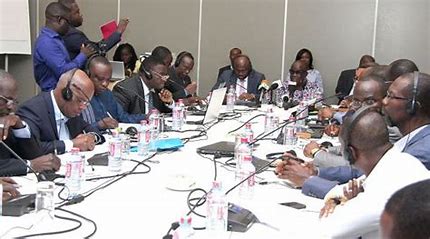
GHANA-TOGO MARITIME DISPUTE: INTERNATIONAL ARBITRATION AN OPTION – TEAM GHANA
GHANA-TOGO MARITIME DISPUTE: INTERNATIONAL ARBITRATION AN OPTION – TEAM GHANA
The government of Ghana has announced that it will not hesitate to seek international arbitration if its counterparts from neighbouring Togo fail to cooperate with Ghana’s Technical Delegation Team that is negotiating a maritime dispute along the eastern border of the country.
Ghana and Togo have failed to come to a consensus after three rounds of negotiations on the maritime boundary demarcations.
The disputed territory is believed to hold oil and gas in commercial quantities.
Already, upstream activities have come to a halt due to an increase in hostile threats from the Togolese naval forces since December last year.
Speaking to Class News, the Head of Ghana’s Technical Delegation Team, Lawrence Apaalse, said the government of Ghana will be forced to opt for international arbitration if the talks are exhausted without a consensus with the Togolese counterparts.
He said: “There’s a timetable for us to reach an agreement and so far, we’ve met three times and we are about to go for the fourth meeting on 14 February although we haven’t confirmed that.
“We hope we will be able to soon reach a consensus but if negotiations fail, then we will be forced to go for other alternatives. As far as maritime situations are concerned, when you fail to reach a consensus you go for international arbitration.”